Wednesday, August 30, 2006

Spare Me The Ryder Cup Machismo

It's almost Ryder Cup time again. I like the event - many of the world's best golf pros playing a team sport. I especially love the team matches, I guess because they're so unique to competitive pro golf. Contrary to the weekly tournaments, every golfer's play counts which makes the event great for the TV audience.

So much for what I like. What I don't like is all the hype that sportswriters and broadcasters feel they have to ad. Just let the thing be, please. It's a beautiful and fun event, isn't that enough. Do we have to hear about all the nationalism involved - 'we hate the Americans, we hate the Europeans, blah blah blah'. Golf my friends isn't about hate. (Actually I do hate to shank, but we're talking human beings here.)

And how does a rivalry fueled by nationalism help anyone on this planet. It doesn't make the players play better. It doesn't help world peace or cure hunger either. Will golf audiences only tune in to see someone from a different country get his ass kicked. I don't believe it, regardless of what the media tries to sell us. Do we have to believe them when they tell us they don't really want to promote negativity, they do it only because audiences demand it.

Well, here's one viewer who hopes they'll see the light and stop the trash talk. Tell us instead about the competition, the strategy or the cigars they're smoking but spare us the Vince Lombardi hype. Here are the world's greatest golfers on a beautiful course playing the kinds of matches many of us play for fun with our friends. It's about enjoyment and that's not to say it's not competitive. Some of the most competitive matches I've ever had have been against my friends.

Tuesday, August 29, 2006

The X Factor and power

I'm going out on a limb again with another bit of advice on the golf swing. I won't denigrate my skill with the clubs again as I've already done that. Proceed at your own risk, check with your doctor and don't blame me if you duck hook your first drive through a course side bay window.

Actually, I think this tip is quite interesting because you don't see it mentioned alot. I was looking at an old golf article the other day about the X Factor. This is something that I believe Jim McLean came up with to explain where the power comes from in a golf swing. Basically the X describes the lines that are created if you looked down at a golfer from above and drew lines through the shoulders and hips. The greater the separation in the lines, the more power you're able to deliver to the golf ball.

Don't worry if you're confused because the tip is actually quite simple. You've got to restrict your hip turn. This makes for a bigger X and therefore more power. But, more importantly in my book, it allows you to hit the ball more cleanly and more consistently. It makes sense if you think about it. When you restrict your hips you create more torque in your torso (sounds like the tag line in a bad ad!). This creates a whole bunch of stored power and all you have to do to get your downswing started is to release your right knee towards the target.

Maybe you're scratching your head about that right knee. It is the key to restricting your hips. Watch the pros, you'll see that many actually point their right knee towards their left at setup. This braces the knee to resist all that turning you're doing on the backswing.

And finally, if you relax and release the right knee, you're more likely to swing with the big muscles of your torso. This is where the real power comes from, not your arms. When you use your arms lots of bad things happen.

Give it a try and let me know how it works.

Wednesday, August 16, 2006

Beta Blockers in Professional Golf!

There's a recent story out of Sports Illustrated that suggests there are drugs in golf - not steroids but beta blockers. Beta blockers are used to combat anxiety, so it doesn't take a genius to understand why they would appeal to some golfers. I've known executives to take a beta blocker before addressing a large audience to calm their nerves.

There is anxiety in every sport, but I believe that golf promotes it more than most. We can relate to placekickers being anxious because they sit on the bench most of the time, performing only occasionally but often under intense pressure. In competitive golf, most every shot must be performed under pressure since it's usually one stroke out of almost 300 that separates the winner from everyone else. And then there's all that time in between shots to just plain worry. It's easy to understand why using anything to reduce this would be tempting.

The question I'm raising is where do we draw the line. What's a drug and what isn't. Caffeine is a drug, a stimulant, and I'll bet that most golfers use it. If you follow downhill ski racing then you probably know that the great Italian slalom racer, Alberto Tomba, was famous for having an espresso just before his start. Everyone knew and no one complained. After all, caffeine is a legal over-the-counter drug. So is an antihistamine for allergies, yet in some sports taking one before competition would get you disqualified.

It all goes to show that what's accepted and what's not is a very gray area, depending on the sport and social custom. Let's make it even grayer. What if I take an herb which functions as a beta blocker. Am I illegally enhancing my performance with a cup of Kava tea. Right now the answer is - only if it is specifically prohibited by the sport's governing body.

Bottom line, it becomes an almost impossible task to decide what's allowed and what's not. If I suffer from allergies, why can't I take a doctor prescribed antihistamine. Then again, you can probably find a doctor somewhere who will write a prescription for anything, so can that be used as a criteria?

The bottom line may be in what actually works. Why ban a substance if it doesn't help athletes win. Apparently testosterone works miracles for bike racers, so ban it. Steroids work for strength based sports like football and slugging home runs in the majors, so ban them. When someone starts beating Tiger because they're on something and not because they're better, then ban it. Until then let it rest.

Tuesday, August 15, 2006

Heliocare - a pill to prevent sun damage?

Can a pill a day help keep sun cancer away? that's the potential of a new supplement called Heliocare, which has been shown to protect skin against the effects of sun exposure.

Part of a new trend in "oral antioxidants", Heliocare's active ingredient is an antioxidant called Polypodium Leucotomos (PL), an extract from ferns native to Central America, which have been used by indigenous people to heal skin problems such as psoriasis and dermatitis.

"Studies show that heliocare helps prevent redness after the skin has been irradiated with ultraviolet light," explains Dr. Leslie Baumann, professor of dermatology at the University of Mimami and author of The Skin Type Solution.

According to IVAX Dermatologicals, Inc, the US distributor of Heliocare, golfers who spend significant time outside should take a second pill three hours after the first dose. At $60 for 60 pills, that adds up – but the benefits could be more than worth it.

- from an article in Woman in Golf by Samantha Hallock

Tuesday, August 01, 2006

No more full iron sets!

Golf manufacturers appear to try and stay up on the latest trends in golf. You'd suppose they have to in order to compete. They spend lots of money trying to convince us that we'll play a lot better if we upgrade our 2 year old clubs.

It's not all hype. I do admit there have been some real game improvement clubs over the last 15 years. Who but the pros can't benefit from perimeter weighting. Try and buy a driver WITHOUT a graphite shaft. Perhaps one of the newest and most helpful inventions has been the hybrid club - half iron and half wood. Most everyone has one, including the PGA pros. On the Champions tour you can't find a bag without one or even more.

It doesn't take much foresight to see where this is going. I've been thinking about possibly upgrading my clubs. As I started to go through the selection process in my mind, I realized I don't really want to buy a full set up irons, 3-PW. Many of us already use wedges that don't match our set, same as most pros. And most amateurs can't and don't hit 2 and 3 irons. Some of us are seeing the light and thinking about getting rid of the 4 as well. Which leaves me wanting to buy a new iron set that goes from 5 through 9. That's four clubs less than I have to buy now, or half a set. I think I'll wait another year or so, in which time a smart manufacturer that makes hybrids and irons is going to offer me the choice to buy only the clubs I really need.

Monday, July 31, 2006

The Secret To Better Golf

I think I can help you play better golf, but you'll have to apply the concepts!

I'm going to do something I thought I never would - offer golf advice. I know this is risky territory, after all who am I to be giving anyone golf advice. I'm not a pro and I've never taught. Heck, I'm not even a scratch player. On the other hand, I've been on a search for a competitive and repetitive golf swing for the last 10 years. I think I've tried most everything. I've hit them left, right, up and down. Which is only to say that I've suffered like everyone else.

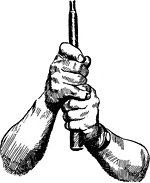
I've analyzed myself, my friends and even my wife. I've watched hundreds, if not thousands, on the practice tee. I've read every instruction book available, yet I couldn't find a magic bullet anywhere. Heck, I couldn't find a good 'visual' for the complete swing. But I do think I've found something that can help most amateur golfers.

Now this assumes you've been playing golf for awhile and have the basic components of grip, stance and swing-plane under control. (If you don't, then nothing is going to help you.) If you're like most, you're not consistent. Some days you're on and some days you're not. You also tend to push or slice most of the time, but occasionally come across the ball and pull it.

I think the hands are the key. Why? Because they ultimately dictate where the club is going to be. I believe the number one fault is getting the hands further away from the body on the downswing than they were on the takeaway. You've got to actively pull your hands in towards your body. If you want to take it a step further, then also manage where your hands are in relation to the ball at impact. At the extremes they're about even with the ball for the driver and some inches ahead for the wedge. Every other club falls in between. (In reality, the hands stay in basically the same place, it's the ball that moves backward from your front foot as you move from the driver through the wedge.)

If you can get your hands in the right position, I believe you will have done more to produce solid consistent shots than anything else. Of course you have to 'release' your wrists at the right time and keep your body behind the ball, but I'm assuming that most golfers understand this.

One last thought for golfers who want to take this 'hands' thing the extra mile. Imagine yourself making the perfect swing. Your hands would describe the perfect circle around your body. This circle has to be as big as possible. (You can still keep your hands close to your body on the downswing and make the circle as big as possible at the same time). I believe this image might help you. I think most golfers end up pulling their hands off this circle and therein lies most of their problems. Some pull off on the way back, some on the way down, and some on the follow-through.

That's as good as I've got. If it makes sense to you, then give it a try. Please let me know how it works out, but don't expect me to cover your golf bets! WARNING: Side effects may include dizziness, euphoria, exuberance or total mental collapse.

Saturday, July 22, 2006

Brown courses are good courses!

I've been watching as much of The Open as I can and it just reminds me how much I love the British style golf courses. There's nary a flat spot on the course, the gorse and heather are everywhere and the course is brown, brown, and brown.

One of the ABC commentators explained how UK greenskeepers only water the grass enough to keep it alive, where US greenskeepers insist on keeping it growing. This would seem to save on maintenance costs and help the environment as well by saving water and probably eliminate a lot of the application of frightening chemicals.

Even if it doesn't do these earth friendly things, the courses look a lot more fun to play. Courses in the US certainly vary from one another, but only to a point. I'd love to be able to get off my steady diet and go out for some scorched earth links once in a while. Don't all those mounds, swales, dips and depressions look interesting versus the flat green monotonous tracks we are all too familiar with here.

And those pot bunkers, sprinkled around a snakey little course to make every hole and every path to the hole an adventure. Talk about risk reward calculations. And it brings a fair amount of luck into the experience, but it's still fair. Every golfer will get their share of bad and good bounces. It's all about how you handle it.

I can't help but think that all golf in the beginning was played this way. 'Shawn, you can aim right on your drive for a better approach to the green, but better make sure you clear the Hangman's rock or you'll play dearly!'

I play a lot of golf on a lovely little 9 hole track on one of the many islands in Narragansett Bay. It really sets up to be a links course. You can see 2 bridges and lots of water. There's tall ocean grass all around and the greens are excellent for a small public course. But somewhere along the way, every bump and dip has been eliminated. The fairways are 100 yards wide in most cases and the few pines that added some challenge have been cut down because of beetles. Now you pretty much sleepwalk until you're on the green. It's still a fun little course, but it could be so much more if they'd kept more of the natural landscape and let it go brown and thrown in some pot bunkers for good measure. The only problem would have been the legions of golfers this layout might have attracted.